Separate mission intent from damaged hardware.
The architectural hypothesis uses hierarchical abstraction so that a change at the physical-resource level can be propagated upward, while a new mission-feasible configuration is derived downward.
Reason about capability across layers.
Damage originates in physical resources, but its consequence is functional and mission-level. The architecture separates these concerns so post-failure reasoning does not depend on one fixed physical implementation.
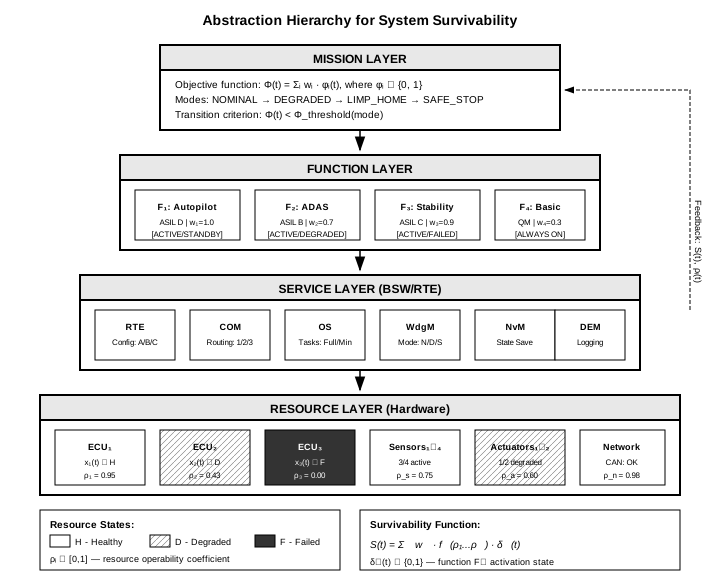
Research-origin diagram from the supplied survivability manuscript; retained here as scientific evidence rather than a marketing illustration.
Two hierarchies, two different jobs.
Abstraction hierarchy
- Mission — admissible mission outcome and minimum functionality.
- Function — active, standby, degraded and disabled functions.
- Service — runtime mapping and selectable software/platform configurations.
- Resource — measured physical/logical operability \(\boldsymbol{\rho}(t)\).
Control-execution hierarchy
- L3 Mission Manager — \(10\,\mathrm{Hz}\), planning and resource allocation.
- L2 Supervisor — \(100\,\mathrm{Hz}\), fault detection and mode switching.
- L1 Servo Control — \(1\,\mathrm{kHz}\), torque/position regulation.
- L0 Hardware — \(10\,\mathrm{kHz}\), sensor/actuator interface and interrupts.
Damage propagates upward. Reconfiguration is decided downward.
Resource degradation changes service availability, functional feasibility and ultimately mission capability.
Mission priorities constrain which functions are retained and how services are remapped to the resources that remain.
The architecture repeatedly evaluates whether the selected configuration remains feasible as the damaged state evolves.
Architecture-level decision before controller adaptation.
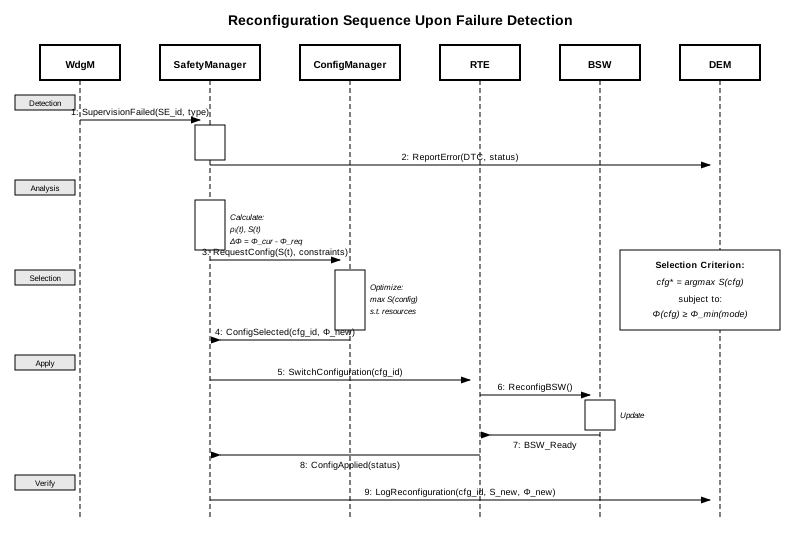
The architecture is a research result under implementation.
The current work is to turn the conceptual layers and reconfiguration sequence into explicit software boundaries, data models, interfaces and executable decision logic.
The implementation should remain traceable to the research assumptions so that experimental results can validate or reject specific architectural mechanisms.
See the publications behind the architecture inside the research library.
Publication status is shown explicitly: published, submitted / under review, preprint or research manuscript.