Back to overview →
Module 04 / 04
Different layers still run at different rates.
The abstraction hierarchy says what the system means. The execution hierarchy says where decisions are computed and how quickly they act.
Different layers still run at different rates.Open section
Control-execution hierarchy
Different layers still run at different rates.
The abstraction hierarchy says what the system means. The execution hierarchy says where decisions are computed and how quickly they act.
- L3 Mission Manager — trajectory objective, priorities and horizon.
- L2 Supervisor — diagnosis, validity, graph planning and reconfiguration.
- L1 Servo Control — plant regulation inside the active configuration.
- L0 Hardware — sensing, actuation, interrupts and physical I/O.
Timing contract
The architecture must satisfy three independent temporal constraints.
SchedulerEach task meets its deadline
\(R_i\le D_i\)
ReactionFault-to-switch latency fits the mode budget
\(\theta+R_{dec}+t_{switch}\le t_{max}\)
EvolutionSwitches are not too frequent
\(t_{k+1}-t_k\ge\tau_d\)
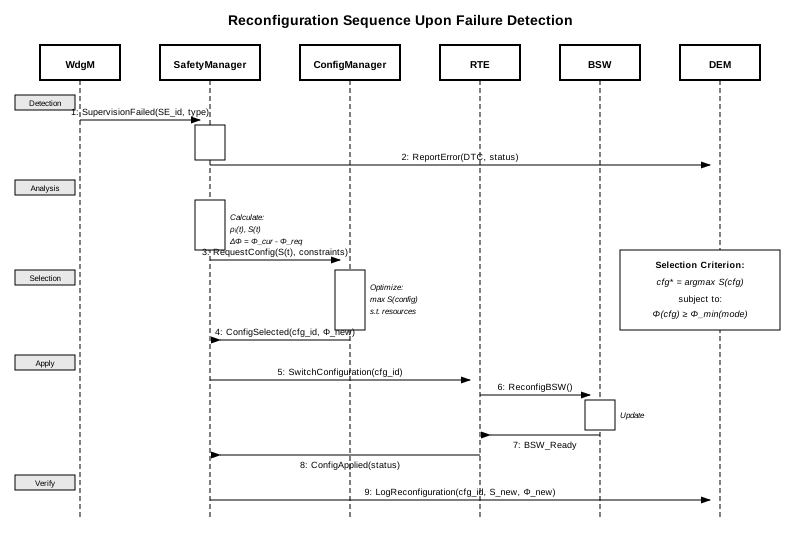
Research evolution
The diagram at left describes the mechanism; the current theory constrains the sequence.
The earlier architecture correctly described diagnosis and structural reconfiguration. The current work adds a quantitative capability model, epistemic validity, transition admissibility, a dwell-time bound and trajectory planning.
Trace the model change →Evidence
Experiments remain the audit trail for every architectural step.
EXP‑01 through EXP‑03 are retained unchanged in scope; the new preprint series formalises the limitations exposed when those mechanisms were generalised.