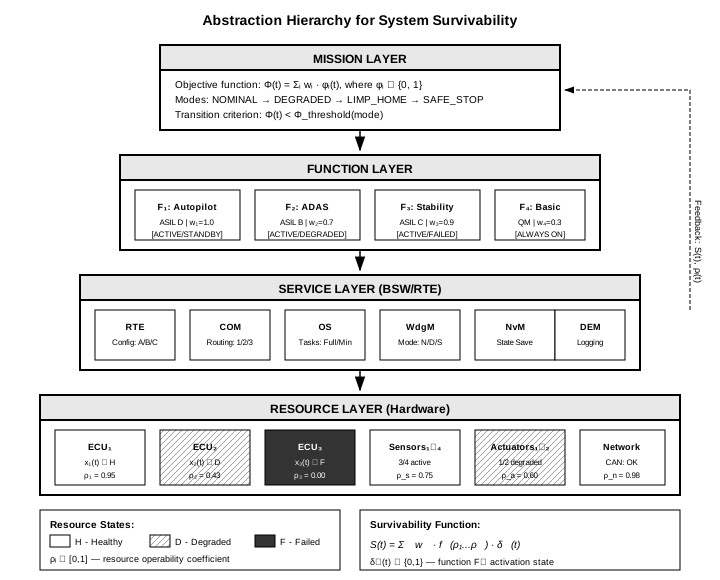
The four-level hierarchy: resource → service → function → mission.
At the core is a constructive link between resources, services, functions and mission. That is what turns survivability into a computable quantity S(t).
Four abstraction levelsExpand section
Four abstraction levels
The super-critical system is represented as a hierarchy: the mission is realized through functions, functions through services, and services through resources.
Rs = {r1 … rn}, Sv = {s1 … sq}, F = {F1 … Fm}
Matrices V, B and WExpand section
Matrices V, B and W
The “service → resource” mapping is given by the matrix V, while “function → service” is given by B. Their product W = B·V yields the resource-to-function influence matrix.
wji = Σk bjk · vki
This matters because the influence matrix is no longer introduced by intuition only, but derived from two physically meaningful mappings.
The survivability formulaExpand section
The survivability formula
Once each resource has its operability coefficient ρi(t), the model rises to the level of functions and mission.
αj — mission priority, δj — activity, φj — integrity.
The framework therefore answers not the vague question “does the system still work?”, but the quantitative one: what fraction of mission capability is still preserved right now?