Reconfigurations form a transformation space, not a list of reactions.
Each admissible configuration is a graph vertex, and each allowed transition is an edge. Reconfiguration thus becomes motion over an evolution graph.
Configurations as vertices, transitions as edgesExpand section
Configurations as vertices, transitions as edges
Once each configuration is described structurally and quantitatively, the framework moves to the transformation space. Configurations C become graph vertices, and admissible transitions T become its edges.
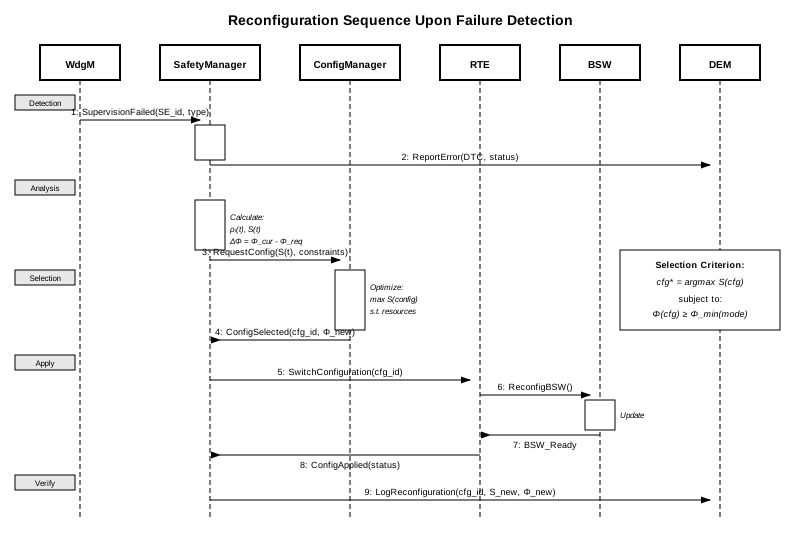
The trajectory, not only the node, is checkedExpand section
The trajectory, not only the node, is checked
A single configuration may be admissible while a sequence of transitions is not. The criterion therefore moves from the level of the node to the level of the trajectory.
Admissible if c(k+1) ∈ T(c(k)) and Δtk ≥ τd
An important design consequence follows: the SAFE_STOP configuration must be terminal.
Automated synthesis of configurationsExpand section
Automated synthesis of configurations
Configuration parameters affect not only local survivability but also the admissible reconfiguration frequency. The catalogue must therefore be synthesized with stability margin, dwell time and the role of terminal configurations in mind.